Most of what goes wrong with a restraint set happens while nobody is using it. Pieces sit against each other for months, hardware presses into soft material, a case gets shut on something that was still damp. None of it shows up the day it happens.
This is the part of ownership nobody writes about, so here it is.
The case is not packaging
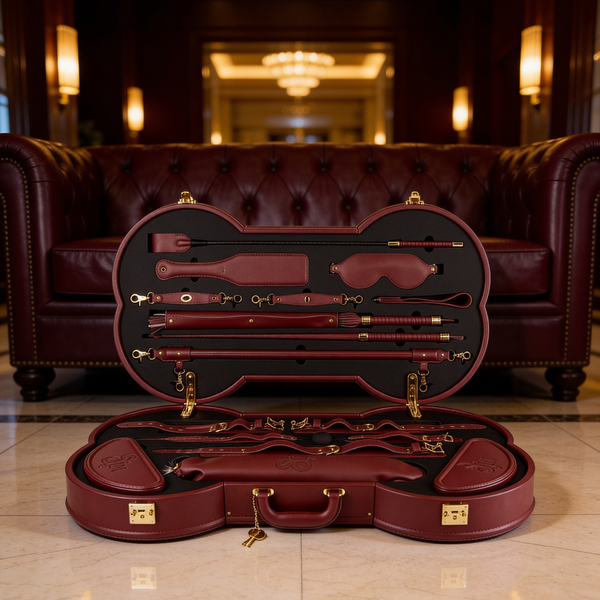
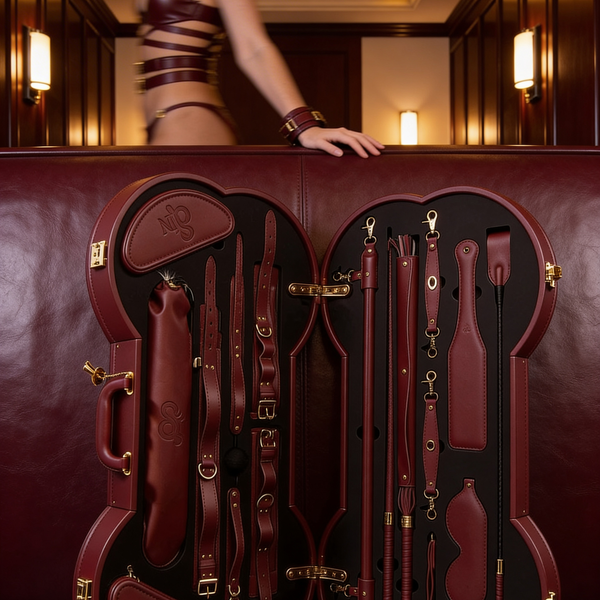
A fitted case with its own recess for each piece is doing two jobs. The first is obvious: everything is in one place that closes. The second matters more over time — nothing presses against anything else.
Pressure is what marks these materials. A buckle resting on a soft strap for a few weeks leaves an impression; on leather it can become permanent. A recess per piece removes the problem entirely, which is why our sets are built around the case rather than shipped in a pouch. The BONE case measures 79 × 44 × 13 cm closed; the PEARL case 511 × 257 × 48 mm.
If you own individual pieces rather than a full set, each one ships in its own round vault case — the same principle at a smaller scale.
Never store anything damp
This is the single rule that matters most, and it is worth repeating in a storage guide because storage is where the damage completes.
Wipe a piece, then let it dry fully before the lid closes. On leather, trapped moisture is the most common cause of ruin — nothing looks wrong at the time, and weeks later the surface has changed.
Dry hardware separately. Metal sitting against damp material is how an even finish becomes a patchy one.
Where to keep the case
- Dry, and out of direct sun. Light fades a finish unevenly over a long enough period, and it fades whatever is facing the window first. A closed case solves this on its own.
- Room temperature. Not a loft, not against a radiator, not a car boot in summer. Heat cycling is hard on leather and on adhesives.
- Never sealed in plastic. A plastic bag traps exactly the moisture you spent time removing. If the case needs to go inside something, use cloth.
- Flat, not on its edge. Pieces stay in their recesses instead of resting on each other.
A case that locks is worth the difference if the set lives in a shared wardrobe rather than a private drawer.
What marks leather in storage
| Italian leather | |
|---|---|
| Put away damp | Severe, often permanent |
| Pressure from hardware | Leaves impressions |
| Long sun exposure | Uneven fading, drying |
| Heat | Stiffening, then cracking |
| Sealed in plastic | Mildew risk |
Travelling with a set
The full signature cases are not carry-on objects — the BONE case alone is 79 cm wide. For travel, take pieces rather than the case.
Wrap each piece separately in cloth so hardware is not touching another piece, and keep them in the middle of a bag rather than against a hard shell. Two or three pieces travel easily; a collar and a pair of cuffs is a realistic set to pack.
Worth knowing before you fly: these read clearly on a scanner, and hardware is metal. Nothing about that is a problem, but pack in checked luggage if being asked about it would bother you.
A reasonable rhythm
Wipe and dry after every use. Return each piece to its recess. Close the case. Look at the leather every few months and condition it when it feels dry. That is the whole routine, and it is enough.
Full material detail is in the care guide, our standing reference lives on the care page, and if you are still choosing, the edition comparison sets the four sets side by side.
Single pieces ship in their own round vault case rather than a full collector case — see the BDSM gear range.